Silver Spring Networks Relay
-
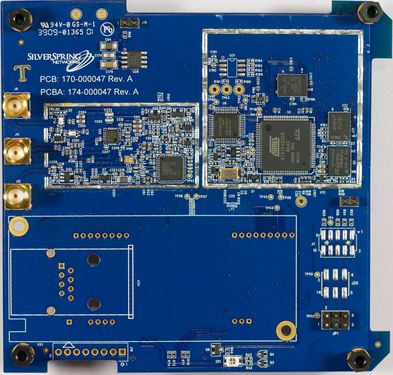 Top of processor board with metal shielding cans removed
 -
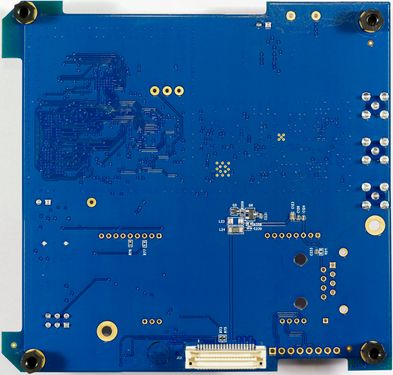 Bottom of processor board


On-air behaviour
(From passive capture of a fixed-AMI NIC 511 network — see Silver Spring Networks Protocol for the frame format.)
A relay is the one node type that beacons on a strict schedule: a 120.000 s lattice, phase holding to σ ≈ 0.25 s over 450+ cycles. Endpoint meters, by contrast, are event-driven (their timing jitters by seconds). This makes the relay easy to pick out.
The beacon (frame length 111 in this variant) carries the relay's own serial plus a neighbour table — its uplink access points (EUI-64 form) and downstream endpoints, each with a link-quality byte. Observed behaviour:
- Dual-homed: a fixed primary + secondary access point, stable across the
whole capture (one link metric steady, the other volatile).
- Channel follows the hop sequence: channel =
slot mod 83on
 the 120 s lattice, so the relay's next beacon channel is predictable from its
 slot index.
- ~60 endpoints were seen routing through a single relay; the relay
forwards their traffic toward the access points.
The relay never sources a unicast we can read — only beacons and inbound acknowledgements — so its own consumption upload goes out on the access point's schedule, not its own.