Ramsey STE-3000 Shielded Test Enclosure: Difference between revisions
Jump to navigation
Jump to search
No edit summary |
No edit summary |
||
| (One intermediate revision by the same user not shown) | |||
| Line 1: | Line 1: | ||
[[File:Ramsey-STE3000-5.jpeg|thumb|Smart Meter in a Faraday cage used to isolate RF signals.]] | [[File:Ramsey-STE3000-5.jpeg|thumb|Smart Meter in a Faraday cage used to isolate RF signals.]] | ||
<br /> | From [[wikipedia:Faraday_cage|Wikipedia]]: A '''Faraday cage''' or '''Faraday shield''' is an enclosure used to block electromagnetic fields. A Faraday shield may be formed by a continuous covering of conductive material, or in the case of a Faraday cage, by a mesh of such materials. Faraday cages are named after scientist Michael Faraday, who invented them in 1836. | ||
<br /><gallery> | |||
File:Ramsey-STE3000-2.jpeg|Closed cage with mesh/plexiglass window for viewing devices under test (DUT) and holes for your hands to interact with DUT using metal mesh gloves. | |||
File:Ramsey-STE3000-1.jpeg|Open Faraday cage, lights can be seen and blade connectors for passing in power. | |||
File:Ramsey-STE3000-3.jpeg|BNC and DB9 on this older unit for passing signals in/out. | |||
File:Ramsey-STE3000-4.jpeg|Internal image with view of gloves | |||
</gallery><br /> | |||
Latest revision as of 23:40, 22 April 2021

From Wikipedia: A Faraday cage or Faraday shield is an enclosure used to block electromagnetic fields. A Faraday shield may be formed by a continuous covering of conductive material, or in the case of a Faraday cage, by a mesh of such materials. Faraday cages are named after scientist Michael Faraday, who invented them in 1836.
-
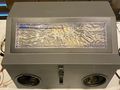 Closed cage with mesh/plexiglass window for viewing devices under test (DUT) and holes for your hands to interact with DUT using metal mesh gloves.
 -
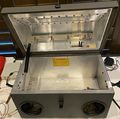 Open Faraday cage, lights can be seen and blade connectors for passing in power.
 -
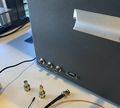 BNC and DB9 on this older unit for passing signals in/out.
 -
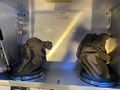 Internal image with view of gloves


