Difference between revisions of "GE Medical Flashpad Digital Xray Detector"
Gamerpaddy (talk | contribs) |
Gamerpaddy (talk | contribs) (added the main script to read & set data) |
||
| Line 1: | Line 1: | ||
==Overview== | ==Overview== | ||
| + | {{Note|UNFINISHED Project, it was not yet possible to retrieve a exposure or dark frame in my testing, further investigation needed. any help is appreciated on recessim discord.}} | ||
The '''GE Flashpad''' is a Digital Radiography image sensor from approximately 2010, originally used in the '''GE Optima 220AMX''' mobile X-ray unit. It was designed to replace analog film in radiology, dramatically reducing image acquisition time from hours to seconds. | The '''GE Flashpad''' is a Digital Radiography image sensor from approximately 2010, originally used in the '''GE Optima 220AMX''' mobile X-ray unit. It was designed to replace analog film in radiology, dramatically reducing image acquisition time from hours to seconds. | ||
| Line 8: | Line 9: | ||
{{Note|All findings on this page are based on a single unit and the time spent working on it. Information is subject to speculation and may not be fully accurate.}} | {{Note|All findings on this page are based on a single unit and the time spent working on it. Information is subject to speculation and may not be fully accurate.}} | ||
| − | {{Note | + | {{Note|AI assistance was used in writing this page for improved formatting and readability, as well as in the process of finding information, testing, and analyzing firmware dumps and backups.}} |
==Purpose and Motivation== | ==Purpose and Motivation== | ||
| Line 531: | Line 532: | ||
(0x0E / 0x0F / 0x10). | (0x0E / 0x0F / 0x10). | ||
| − | ==Reading the Drop and Shock Event Log== | + | ===Reading the Drop and Shock Event Log=== |
The detector contains an accelerometer based shock watchdog that records drop | The detector contains an accelerometer based shock watchdog that records drop | ||
| Line 539: | Line 540: | ||
in the small onboard EEPROM on the detector PCB. | in the small onboard EEPROM on the detector PCB. | ||
| − | ===How to read it=== | + | ====How to read it==== |
The shock log is exposed as data category 0x72 on the upload (read) interface. | The shock log is exposed as data category 0x72 on the upload (read) interface. | ||
| Line 550: | Line 551: | ||
(32 KB I2C part) for anyone reading the hardware directly. | (32 KB I2C part) for anyone reading the hardware directly. | ||
| − | ===Example output=== | + | ====Example output==== |
The following is the actual log read from detector serial UA45829-7. The file | The following is the actual log read from detector serial UA45829-7. The file | ||
| Line 589: | Line 590: | ||
157804584600183, 149266438700135 } | 157804584600183, 149266438700135 } | ||
| − | ===Interpreting the records=== | + | ====Interpreting the records==== |
The record key encodes the event time and the peak axis values (an epoch style | The record key encodes the event time and the peak axis values (an epoch style | ||
| Line 618: | Line 619: | ||
|} | |} | ||
| − | ===Reading the summary fields=== | + | ====Reading the summary fields==== |
{| class="wikitable" | {| class="wikitable" | ||
| Line 755: | Line 756: | ||
| + | == Teardown / Internal Pictures / Hardware analysis == | ||
| + | <gallery mode="packed" heights="200"> | ||
| + | File:GE Flashpad under the hood.jpg|the Carbon fiber sleeve is held by 9 screws and can taken off without force. | ||
| + | File:Ge flashpad powersupply pcb in handle.jpg|Power supply PCB | ||
| + | File:Ge flashpad uwb board pcb.jpg|UWB PCB for Wireless USB using a RTU2705 | ||
| + | File:Ge flashpad uwb pcb backside.jpg|Backside of UWB PCB | ||
| + | File:Ge flashpad power supply pcb backside.jpg|Backside of Power supply PCB | ||
| + | File:Ge flashpad main pcb closeup1.jpg|Main area of the PCB with its Altera Cyclone 3 FPGA | ||
| + | File:Ge flashpad main pcb closeup2.jpg|AD7892 is a 600ksps 12bit ADC, SN74LVC8T245 a 8bit bus transceiver and DG9408EDN a 8ch MUX | ||
| + | File:Ge flashpad bottom connector ethernet isolation pcb.jpg|Isolation PCB for bottom connector | ||
| + | File:Ge flashpad main pcb powersupply section.jpg|Powersupply section for FPGA and ROIC | ||
| + | File:Ge_flashpad_main_pcb_closeup_3.jpg|AD9764AR 14-Bit, 125 MSPS DAC and DS1682 integrated elapsed-time recorder | ||
| + | File:Ge flashpad main pcb closeup 4.jpg|Accelerometer is a 834-0500 500G 3 Axis unit, and TJ500AE SPDT gigabit LAN switch | ||
| + | File:Ge flashpad bottom connector.jpg|bottom connector for docking stand | ||
| + | File:Ge flashpad main pcb closeup 5.jpg|Ethernet transformers and ADM34 RS-485/RS-422 Transceiver | ||
| + | File:Ge flashpad main pcb closeup 6.jpg|Altera EPM570f100c5n CPLD | ||
| + | File:Ge flashpad main pcb closeup 7.jpg|Spansion GL512P10FF1R1 512 Mbit NOR flash IC holding everything | ||
| + | File:Ge flashpad main pcb closeup 8.jpg|24LC256I 32k EEPROM for storing the accelerometer events | ||
| + | </gallery> | ||
| − | ===Known Dead Ends | + | |
| + | |||
| + | |||
| + | == Main test py script: Usage and Parameters == | ||
| + | |||
| + | current iteration found here: https://pastebin.com/vEfAresk | ||
| + | |||
| + | flashpad_acquire.py is a single file Python 3 tool that speaks the FlashPad | ||
| + | URP/PDAP protocol over UDP. It implements discovery, the control handshake, | ||
| + | script download and execution, sensor readout, full data backup, and the host | ||
| + | registration (pairing) write. It requires only the Python standard library. | ||
| + | |||
| + | === Default network configuration === | ||
| + | |||
| + | These defaults match the values in ConnectionPoint.cfg and can be overridden on | ||
| + | the command line. | ||
| + | |||
| + | {| class="wikitable" | ||
| + | ! Setting !! Default !! Meaning | ||
| + | |- | ||
| + | | Detector IP || 192.168.1.30 || the panel; listens for all commands on UDP 8100 | ||
| + | |- | ||
| + | | Host IP || 192.168.1.1 || this machine, announced in SYSTEM_STARTUP | ||
| + | |- | ||
| + | | Detector port || 8100 || where commands are sent | ||
| + | |- | ||
| + | | Host command port || 5550 || where the detector returns protocol replies | ||
| + | |- | ||
| + | | Host image port || 6660 || where pixel data would stream | ||
| + | |- | ||
| + | | Discovery port || 4500 || where the detector sends its beacons | ||
| + | |} | ||
| + | |||
| + | === Connection and general options === | ||
| + | |||
| + | {| class="wikitable" | ||
| + | ! Option !! Default !! Effect | ||
| + | |- | ||
| + | | --detector-ip IP || 192.168.1.30 || detector address | ||
| + | |- | ||
| + | | --host-ip IP || 192.168.1.1 || host address sent in SYSTEM_STARTUP | ||
| + | |- | ||
| + | | --output-dir DIR || . || where raw images are written | ||
| + | |- | ||
| + | | --timeout SECONDS || 5.0 || UDP receive timeout | ||
| + | |- | ||
| + | | --exec-timeout SECONDS || 60 || how long to wait for EXECUTION_COMPLETE | ||
| + | |- | ||
| + | | --skip-discovery || off || send SYSTEM_STARTUP once and proceed, skipping the discovery loop | ||
| + | |- | ||
| + | | --quiet || off || suppress the verbose per packet log | ||
| + | |} | ||
| + | |||
| + | === Read and diagnostic modes (non destructive) === | ||
| + | |||
| + | These only read from the detector. None of them write anything. | ||
| + | |||
| + | {| class="wikitable" | ||
| + | ! Option !! What it does !! What to expect | ||
| + | |- | ||
| + | | --sensors || Reads the full 32 entry sensor table using cmd 0x7902 (converted) and 0x7900 (raw), side by side. || A decoded table of supply rails in volts. Temperatures show as railed. Unimplemented sensors (accelerometer DEM id, battery, grid) are flagged as stale. | ||
| + | |- | ||
| + | | --no-roe-init || With --sensors, skips the Script7 ROE init before reading. || Slightly faster sensor read, marginally less reliable. | ||
| + | |- | ||
| + | | --probe-data || Reads DetectorInfo, the HostList (registration state), and cal results via the upload protocol (cmd 0x13/0x14). || A hexdump and text decode of each. Shows whether any host is registered and which HostId the detector expects. | ||
| + | |- | ||
| + | | --backup [DIR] || Sweeps all upload IDs 0x00 to 0xFF and saves every readable blob to DIR/detector_backup_timestamp/. || A manifest plus one .bin per readable ID, including the full 64 MB flash image and the calibration maps. Do this before any write. Large blobs take a few minutes each. | ||
| + | |- | ||
| + | | --backup-range LO-HI || Limits the --backup sweep, for example 0x40-0xA0. || Faster, partial backup. | ||
| + | |- | ||
| + | | --dump-scripts || Prints the wire bytes of all built scripts as hex and exits. || No network activity; useful for inspecting the script encoding. | ||
| + | |- | ||
| + | | --listen || Passively listens on the host command port for 30 seconds. || Prints any packets the detector sends; useful for watching beacons. | ||
| + | |} | ||
| + | |||
| + | === Acquisition modes === | ||
| + | |||
| + | The default invocation (no mode flag) runs a standard acquisition, which | ||
| + | requires an actual X-ray exposure to complete. | ||
| + | |||
| + | {| class="wikitable" | ||
| + | ! Option !! What it does !! What to expect | ||
| + | |- | ||
| + | | (no flag) || Standard acquisition (Script 0). || Needs an X-ray exposure to reach EXECUTION_COMPLETE. | ||
| + | |- | ||
| + | | --dark || Runs the dark/offset acquisition (Script 1) before the standard one. || Two acquisitions; the dark one needs no X-ray. | ||
| + | |- | ||
| + | | --dark-only || Runs only the dark acquisition (Script 1). || Completes in a few seconds with no X-ray. The detector acquires and holds an 8 buffer image. Best way to test the full flow. | ||
| + | |- | ||
| + | | --no-standby || Omits the Script 8 standby loop. || Use if the standby loop blocks acquisition. | ||
| + | |- | ||
| + | | --two-exec || Executes Script 7 alone, waits, then Script 1. Only with --dark-only. || Tests the two stage execution hypothesis. | ||
| + | |- | ||
| + | | --parallel || Answers the detector status query (0x30000) with the cmd 0x99 ParallelImageTransfer reply instead of cmd 9. || Experiment to see if the parallel reply triggers a pixel push. (Result so far: it does not.) | ||
| + | |- | ||
| + | | --sweep-acq || Sweeps the dark acquisition across type_mode and transfer_mode values, watching for a 0x0F pixel push. || Non destructive experiment; reports which combination, if any, makes the detector stream. | ||
| + | |- | ||
| + | | --preview || Single dark acquisition on the preview path (transfer_mode 2, 4 buffer image). Watches port 6660 for a push. || One clean connection; run a packet capture on the detector address in parallel. | ||
| + | |} | ||
| + | |||
| + | Note: at present the detector acquires and holds an image but does not push the | ||
| + | 0x0F pixel frames. The acquisition modes complete the handshake and acquisition, | ||
| + | but image streaming is still being investigated. | ||
| + | |||
| + | === Registration and write operations === | ||
| + | |||
| + | These can write to the detector's flash. Every write is a dry run by default and | ||
| + | only takes effect when --commit is added. Always run --backup first. | ||
| + | |||
| + | {| class="wikitable" | ||
| + | ! Option !! What it does | ||
| + | |- | ||
| + | | --register-self || Adds this host to the detector HostList and sets it as the primary host, so the detector should stream images to it. Appends an entry, sets IndexToPrimaryHost, recomputes the CRC, and writes via id 0x71. Dry run unless --commit. | ||
| + | |- | ||
| + | | --host-mac MAC || The MAC of the interface talking to the detector, used to derive this host's HostId for --register-self. Default 00:6f:00:01:0a:3a. | ||
| + | |- | ||
| + | | --smoke-test-write || Reads the HostList and writes back the identical bytes to validate the write and commit path without changing anything. Dry run unless --commit. | ||
| + | |- | ||
| + | | --restore-hostlist FILE || Writes a saved HostList blob (for example detector_backup_*/upload_0x71_504.bin) back to the detector. This is the undo button. Dry run unless --commit. | ||
| + | |- | ||
| + | | --commit || Arms the actual flash write for the operations above. Without it they only print what they would do. This writes the detector's flash and is irreversible at the chip level, although the HostList region can be restored from a backup. | ||
| + | |} | ||
| + | |||
| + | === Typical workflow === | ||
| + | |||
| + | # Read the current state: <code>python flashpad_acquire.py --probe-data</code> | ||
| + | # Make a full backup: <code>python flashpad_acquire.py --backup</code> | ||
| + | # Check sensors and power rails: <code>python flashpad_acquire.py --sensors</code> | ||
| + | # Dry run the registration: <code>python flashpad_acquire.py --register-self --host-mac YOUR:MAC</code> | ||
| + | # When satisfied, commit it: add <code>--commit</code> | ||
| + | # If needed, undo: <code>python flashpad_acquire.py --restore-hostlist detector_backup_*/upload_0x71_504.bin --commit</code> | ||
| + | |||
| + | |||
| + | |||
| + | == Known Dead Ends == | ||
Things that were tried and did not work or led nowhere: | Things that were tried and did not work or led nowhere: | ||
| Line 775: | Line 929: | ||
;Image data streaming automatically after EXECUTE_SCRIPT | ;Image data streaming automatically after EXECUTE_SCRIPT | ||
:Frames may not push during execution at all. The detector may require an explicit IMAGE_RETRIVAL_REQUEST (cmd_type=0x41) and IMAGE_RETRIVAL (cmd_type=0x98) after the 0x30000 notification before it streams anything. Not yet tested. | :Frames may not push during execution at all. The detector may require an explicit IMAGE_RETRIVAL_REQUEST (cmd_type=0x41) and IMAGE_RETRIVAL (cmd_type=0x98) after the 0x30000 notification before it streams anything. Not yet tested. | ||
| − | |||
| − | |||
| − | |||
| − | |||
| − | |||
| − | |||
| − | |||
| − | |||
| − | |||
| − | |||
| − | |||
| − | |||
| − | |||
| − | |||
| − | |||
| − | |||
| − | |||
| − | |||
| − | |||
| − | |||
| − | |||
| − | |||
| − | |||
| − | |||
| − | |||
| − | |||
Revision as of 12:13, 11 June 2026
Contents
- 1 Overview
- 2 Purpose and Motivation
- 3 Technical Specifications
- 4 Hardware Features
- 5 Communication Protocol
- 6 Sensor Readout and Host Registration
- 7 FlashPad Detector: Internal Flash Dump and Data Files
- 8 Teardown / Internal Pictures / Hardware analysis
- 9 Main test py script: Usage and Parameters
- 10 Known Dead Ends
Overview
The GE Flashpad is a Digital Radiography image sensor from approximately 2010, originally used in the GE Optima 220AMX mobile X-ray unit. It was designed to replace analog film in radiology, dramatically reducing image acquisition time from hours to seconds.

Due to its high original cost and specialized application, used units occasionally appear on professional B2B marketplaces in the $15,000–$50,000 range. On eBay, prices typically fall between $1,500 and $5,000, though units at this price point are often in poor condition and may fail the built-in self-test or not function at all.
Purpose and Motivation
This project documents the reverse engineering of the GE FlashPad wireless digital radiography detector used with the Optima XR200/220 AMX mobile X-ray system, with the goal of freeing these detectors for independent use.

Large numbers of these detectors reach the used market, but each one is cryptographically and administratively bound to its original Optima 220 AMX console. Once separated from that console, or once the console is decommissioned, the detector is effectively useless even though the hardware is fully functional. The aim of this work is to remove that artificial barrier so that a standalone FlashPad can be paired, configured, and read out by any host, without the half million dollar console it was sold with.
The intended beneficiaries are:
- Hobbyists, researchers, and engineers who want a high quality flat panel detector for their own imaging projects.
- Veterinary practices, which can put surplus human grade detectors to good use at a fraction of the cost of new equipment.
- Clinics and hospitals in countries and regions where a complete commercial system is unaffordable, allowing serviceable detectors to keep providing diagnostic imaging instead of being scrapped.

This is done for human good. Every detector returned to service is one less piece of working medical hardware sent to landfill, and potentially one more place that can offer X-ray imaging where it otherwise could not.
All files, findings, protocol documentation, and tools produced by this project are public and open source, so that anyone can study, reproduce, and build on the work.
Technical Specifications


The Flashpad uses a ~40 × 40 cm CsI scintillator bonded to a TFT photodetector array mounted on glass. The assembly is highly sensitive to shock and impact damage. See section drop and shock event log
| Parameter | Value |
|---|---|
| Resolution | 2048 × 2048 px |
| Bit depth | 16-bit per pixel |
| Spatial resolution | Up to 5 lp/mm (theoretical) |
| Scintillator material | Caesium iodide (CsI) |
| Detector type | TFT photodetector array (glass substrate) |
| Panel size | ~40 × 40 cm |
The theoretical 5 lp/mm spatial resolution is primarily limited in practice by the focal spot size of the X-ray source. Use of an anti-scatter grid can improve effective resolution.
Status of Reverse Engineering
| What | Status |
|---|---|
| Connect, beacon, ACK | Works |
| PORT_SETUP | Works |
| SIGNATURE_REQUEST / serial number readout | Works |
| Script download (Scripts 7, 8, 1) | Works |
| EXECUTE_SCRIPT | Works |
| EXECUTION_COMPLETE (dark acquisition) | Works but without image readout its speculation. |
| EXECUTION_COMPLETE (standard acquisition) | Needs real X-ray trigger to test |
| Image data on port 6660 | Does not work yet, under investigation. Will not send Imagedata... |
Hardware Features
Shock logging
The unit contains an internal accelerometer that logs significant shock events — but only when a battery is inserted. As there is no backup battery, shock events occurring while unpowered are not recorded.
Wireless connectivity
Some units include a UWB transmitter for Wireless USB; others may be equipped with a Wi-Fi module instead. The detector can also be operated over the tethered connection alone.
Ethernet interface
There is a 100MBit Ethernet interface trough the Tether Cable which can be tapped and used for Communication. Exposed metal contacts on the bottom connector are isolated via relays by default. Enabling Gigabit Ethernet connectivity requires shorting or driving two specific pins. This has not been investigated further at this time.
Communication Protocol
This section documents the URP/PDAP protocol used by the GE Flashpad (codename Apollo) to communicate with a host over Ethernet. All findings are based on live capture tests, configuration files, and reverse-engineering of the GE SuperBee software stack.
Network Setup
All findings were over Ethernet only, no UWB or WIFI has been used.
Default detector IP is 192.168.1.30. Set your host to a static IP in the same subnet, 192.168.1.1 works fine.
At first by sending random bytes over Python it answered to port 48879 (0xBEEF), which seems to be either the default port or set by Python. After SYSTEM_SETUP it got set to 5550.
| Role | IP | Port | Direction |
|---|---|---|---|
| All commands: host -> detector | 192.168.1.30 | 8100 (UDP) | Host sends here |
| Discovery beacons: detector -> host | - | 4500 (UDP) | Detector sends here initially |
| Protocol replies: detector -> host | - | 5550 (UDP) | Detector sends here after setup |
| Image pixel data: detector -> host | - | 6660 (UDP) | Detector streams frames here |
In practice you can listen on port 5550 for everything (beacons and replies) by advertising that port in both SYSTEM_STARTUP and PORT_SETUP. The detector sends to whichever port was most recently configured.
Protocol Layers
Two layers, carried over UDP:
- URP (Unified Registration Protocol)
- 8-byte wrapper on every packet. Handles sequencing and acknowledgement.
- PDAP (Proprietary Detector Access Protocol)
- The actual command layer, present inside URP packets when
CmdFlag = 0.
Every UDP packet starts with a URP header:
[SeqId : 4 bytes LE] [CmdFlag : 4 bytes LE]
CmdFlag = 0-- data packet, PDAP command follows.CmdFlag = 1-- bare ACK, no PDAP body. SeqId echoes the packet being acknowledged.
Both sides must ACK every data packet immediately. The detector silently drops packets with a SeqId it has already seen, so always increment SeqId for each new command.
When CmdFlag is 0, the PDAP header follows immediately:
[cmd_type : 4 bytes LE] [payload_len : 4 bytes LE] [payload ...]
Connecting to the Detector
The connection sequence is:
- Broadcast
SYSTEM_STARTUPto tell the detector where to reply. - The detector sends a
BEACONback -- ACK it and sync your sequence counter. - Send
PORT_SETUPto configure the reply and image ports. - Send
SIGNATURE_REQUESTto read the detector identity (serial number, model, firmware, MAC).
Step 1: SYSTEM_STARTUP
Broadcast UDP to 192.168.1.255:8100. Always uses SeqId = 0.
URP : [00 00 00 00]  SeqId = 0
      [00 00 00 00]  CmdFlag = 0
PDAP: [01 00 00 00]  cmd_type = 1
      [06 00 00 00]  payload_len = 6
      [15 AE]        host reply port = 5550 (big-endian)
      [C0 A8 01 01]  host IP = 192.168.1.1 (network byte order)
import socket, struct

sock = socket.socket(socket.AF_INET, socket.SOCK_DGRAM)
sock.setsockopt(socket.SOL_SOCKET, socket.SO_BROADCAST, 1)
sock.bind(("0.0.0.0", 5550))

HOST_IP   = "192.168.1.1"
DET_IP    = "192.168.1.30"
HOST_PORT = 5550
IMG_PORT  = 6660

def make_urp_packet(seq_id, pdap_bytes):
    return struct.pack("<II", seq_id, 0) + pdap_bytes

pdap = struct.pack("<II", 1, 6) + struct.pack(">H", HOST_PORT) + socket.inet_aton(HOST_IP)
sock.sendto(make_urp_packet(0, pdap), ("192.168.1.255", 8100))
Step 2: Receiving the BEACON and ACKing
The detector broadcasts a BEACON (cmd_type=1) roughly every 2 seconds. After sending SYSTEM_STARTUP you should get one quickly. Parse the detector SeqId from the URP header and ACK it:
data, addr = sock.recvfrom(4096)
det_seq = struct.unpack_from("<I", data, 0)[0]

# send bare ACK
ack = struct.pack("<II", det_seq, 1)
sock.sendto(ack, (DET_IP, 8100))

# all subsequent commands start from here
host_seq = det_seq + 1
Step 3: PORT_SETUP
Tells the detector which host ports to use for replies and image data.
PDAP: [02 00 00 00]  cmd_type = 2
      [04 00 00 00]  payload_len = 4
      [15 AE]        host cmd port = 5550 (big-endian)
      [1A 04]        host image port = 6660 (big-endian)
pdap = struct.pack("<II", 2, 4) + struct.pack(">HH", HOST_PORT, IMG_PORT)
sock.sendto(make_urp_packet(host_seq, pdap), (DET_IP, 8100))
host_seq += 1
# expect bare ACK from detector
Step 4: Reading the Serial Number (SIGNATURE_REQUEST)
Empty command, the detector replies with a 54-byte payload containing its identity.
pdap = struct.pack("<II", 3, 0)   # cmd_type=3, payload_len=0
sock.sendto(make_urp_packet(host_seq, pdap), (DET_IP, 8100))
host_seq += 1

# reply is 70 bytes total: 8 URP + 8 PDAP header + 54 payload
data, _ = sock.recvfrom(4096)
payload = data[16:]   # skip URP (8) + PDAP header (8)

mac      = payload[0:6]
serial   = payload[22:34].rstrip(b'\x00 ').decode()
model    = payload[34:46].rstrip(b'\x00 ').decode()
fw_bytes = payload[46:54]
firmware = ".".join(str(b) for b in fw_bytes)

print(f"MAC:      {':'.join(f'{b:02X}' for b in mac)}")
print(f"Serial:   {serial}")
print(f"Model:    {model}")
print(f"Firmware: {firmware}")
Expected output:
MAC:      40:F4:A0:00:78:4D
Serial:   UA45829-7
Model:    5340000-7
Firmware: 1.6.0.4.2.0.1.3
Running an Acquisition
After the connection sequence above, download scripts to the detector and then execute them.
ROE Initialisation (Script 7)
Always run this first. It initialises the readout electronics and takes about 4-5 seconds. The detector sends host event ID 17 when done.
Dark / Offset Acquisition (Script 1)
No X-ray source required. Runs a dark-field exposure for offset calibration. Use this to verify the acquisition pipeline without a generator.
Standard Acquisition (Script 0)
Requires an actual X-ray exposure. EXECUTION_COMPLETE will not arrive without a real X-ray trigger.
Sequence Overview
HOST                                     DETECTOR
 |                                           |
 |-- SYSTEM_STARTUP (broadcast) ----------->|
 |<- bare ACK -------------------------------|
 |<- BEACON (cmd_type=1) --------------------|
 |-- bare ACK ------------------------------>|
 |                                           |
 |-- PORT_SETUP (cmd_type=2) -------------->|
 |<- bare ACK -------------------------------|
 |                                           |
 |-- SIGNATURE_REQUEST (cmd_type=3) ------->|
 |<- SIGNATURE_REPLY (54 bytes) -------------|
 |-- bare ACK ------------------------------>|
 |                                           |
 |-- GENERIC_SCRIPT Script7 (ROE init) ---->|
 |<- bare ACK or SCRIPT_DOWNLOAD_REPLY ------|
 |                                           |
 |-- GENERIC_SCRIPT Script1 (dark acq) ---->|
 |<- bare ACK -------------------------------|
 |                                           |
 |-- EXECUTE_SCRIPT (cmd_type=6) ---------->|
 |<- bare ACK -------------------------------|
 |<- EXECUTE_SCRIPT_REPLY (~230ms) ----------|
 |-- bare ACK ------------------------------>|
 |<- DETECTOR_STATE_NOTIFY (~890ms) ---------|  state_id=17
 |-- bare ACK ------------------------------>|
 |                                           |
 |<- EXECUTION_COMPLETE (0x10000) -----------|
 |-- bare ACK ------------------------------>|
 |                                           |
 |<- IMAGE_XFER_STATUS_QUERY (0x30000) ------|
 |-- bare ACK ------------------------------>|
 |-- IMAGE_XFER_STATUS_REPLY (cmd_type=9) ->|  numMissed=0
 |<- bare ACK -------------------------------|
Sequence Counter Rules
SYSTEM_STARTUPalways usesSeqId = 0.- After the first beacon, set host SeqId to beacon_SeqId + 1.
- Increment SeqId by 1 for every new data packet (CmdFlag=0).
- Bare ACKs echo the SeqId of the packet being acknowledged and do not consume a SeqId.
- The detector silently drops any packet with a SeqId it has already processed, so never reuse one.
Sensor Readout and Host Registration
This section documents the reverse engineered sensor telemetry interface and the host registration (pairing) mechanism of the GE Optima XR200/220 AMX FlashPad (URP detector, SuperBee, FW 1.6.0.4.2.0.1.3). All commands are PDAP over UDP to the detector at port 8100; replies return to the host command port.
Sensor Readout
The detector exposes an analog sensor interface (the DEM, Detector Environment Monitor) that is independent of the image transfer path and works regardless of acquisition state.
Commands
| cmd_type | Meaning | Request payload | Reply payload |
|---|---|---|---|
| 0x7900 | Raw sensor read | [sensorId:4 LE] | [value:4 LE] (12 bit ADC count) |
| 0x7902 | Converted sensor read | [sensorId:4 LE] | [value:4 LE] (engineering units, signed) |
| 0x7904 | Detailed / radio | [selector:4 LE] | [value:4 LE] |
Note: cmd 0x7902 IS supported on this firmware and returns calibrated engineering units (millivolts for the supply rails, signed; 0.1 degree C for temperatures). Earlier documentation that marked 0x7902 as unsupported is incorrect. The host side conversion coefficients are not required; the detector performs the conversion internally.
The full sensor map (name, sensorId) was recovered from the detector's own [Sensor] configuration table, read back over the upload interface (see the Registration section for the read protocol).
Power rails (live readings)
All supply rails read correctly via 0x7902 and are within normal range for a flat panel detector. Representative readings:
| Sensor | sensorId | Converted | Value |
|---|---|---|---|
| DCIN_RAW | 10 | 12100 mV | +12.10 V (main DC input) |
| LCORE_UNREG | 11 | 1724 mV | +1.72 V |
| LPANA_UNREG | 12 | 5776 mV | +5.78 V |
| LNANA_UNREG | 13 | -5801 mV | -5.80 V |
| SCAN_VCC | 14 | 5086 mV | +5.09 V (gate driver) |
| P5V_REF | 16 | 5025 mV | +5.03 V (5 V reference) |
| V_ON | 17 | 11085 mV | +11.09 V (TFT gate on) |
| V_OFF | 18 | -12378 mV | -12.38 V (TFT gate off) |
| V_COMMON | 19 | -9385 mV | -9.39 V |
| 3V3 | 29 | 3177 mV | +3.18 V (3.3 V logic) |
| VCC_UNREG | 37 | 3399 mV | +3.40 V |
| PARCPREG | 38 | 3768 mV | +3.77 V (ARC preamp +) |
| NARCPREG | 39 | -3732 mV | -3.73 V (ARC preamp -) |
| PANA_UNREG | 45 | 18352 mV | +18.35 V (photodiode bias +) |
| NANA_UNREG | 46 | -19251 mV | -19.25 V (photodiode bias -) |
Switched rails that are inactive while the panel is idle (PARCVA_U, P5VA_SW, N5VA_SW, FGATE_NVC_L, FGATE_PVC_L, etc.) read at or near zero.
Known limitations
- Temperatures (Temp_Surface, sensorId 336; Temp_Panel, sensorId 352): the raw 0x7900 read rails at 0x3FF (1023, the ADC maximum), indicating an open thermistor path while the panel is idle. This is a hardware/state condition, not a command problem, and the temperature is not readable from the host in this state.
- Unimplemented sensors: sensorIds 70 (Accelerator), 78 (Gravity), and 256 to 259 (Battery status, name, life, capacity), and 272 (Grid status) are not implemented on this DEM. The detector returns the leftover conversion register contents (a duplicate of a previously read sensor) rather than a real value, so these rows must be discarded.
- Accelerometer: functional through a separate addressing scheme using raw cmd 0x7900 with selectors 0x42 (X), 0x43 (Y), 0x44 (Z), returning 12 bit per axis counts.
Host Registration (Pairing)
URP stands for Unified Registration Protocol. The detector maintains a host list in its internal NOR flash. Image data is delivered only to a registered primary host, so registration is a prerequisite for image transfer.
Host identity (MAC and HostId)
Each host is identified by a 16 character HostId derived deterministically from the host's eth0 MAC address. The derivation (from the vendor generateHostId script) is:
- Take the eth0 MAC, remove the colon separators, convert to upper case (12 hex characters).
- Prepend the last 4 characters to the full 12 characters.
- The result is 16 hex characters.
Example: MAC 00:6f:00:01:0a:3a becomes 006F00010A3A, then the last four (0A3A) are prepended, giving HostId 0A3A006F00010A3A.
HostList structure
The host list is stored in flash at offset 0x940000 and can be read back over the upload interface as data category 0x71. Layout:
Offset  Size  Field
0x00    16    DetectorDeviceId (ASCII)
0x10    16    ConnectionSecretKey (ASCII; "XXXXXXXXXXXXXXXX" when unset)
0x20    16    DetectorName (ASCII)
0x30    16    DetectorCode (ASCII)
0x40     2    CurrentNumberOfHosts (uint16 LE)
0x42     2    IndexToPrimaryHost (uint16 LE; 0xFFFF = none)
0x44   144*N  Host entries, 144 bytes each:
                +0x00  16  HostId (ASCII)
                +0x10  ..  host name / department string
                +0x50  ..  location string
...      4    CRC (big endian; see below)
HostList from the unit under test
Detector: MAC 40:F4:A0:00:78:4D, serial UA45829-7, model 5340000-7, firmware 1.6.0.4.2.0.1.3. DetectorName starShape_green. ConnectionSecretKey unset. CurrentNumberOfHosts = 3, IndexToPrimaryHost = 0xFFFF (no primary host).
| Index | HostId | Derived MAC | Name |
|---|---|---|---|
| 0 | 2C6400045FB42C64 | 00:04:5F:B4:2C:64 | Haus 207 / ITS |
| 1 | B044E8393512B044 | E8:39:35:12:B0:44 | Not Initialized |
| 2 | 5CF800045FB15CF8 | 00:04:5F:B1:5C:F8 | Not_Initialized |
The unit is therefore not factory fresh; it carries registrations from a prior deployment, but no primary host is currently designated.
Checksum (CRC)
The HostList (and other flash data blobs) are protected by a 4 byte trailing CRC. Parameters:
- Polynomial: 0x04C11DB7
- Initial value: 0
- MSB first, augmented message style (the data bit is shifted into the LSB; no input or output reflection; no final XOR)
- Stored big endian
To generate: compute the CRC over the data followed by four zero bytes, then append the result big endian. Verification: the CRC over (data plus stored CRC) equals zero.
def crc(data, poly=0x04C11DB7, init=0):
    c = init
    for byte in data:
        for bit in (0x80,0x40,0x20,0x10,0x08,0x04,0x02,0x01):
            msb = c & 0x80000000
            c = (c << 1) & 0xFFFFFFFF
            if byte & bit: c |= 1
            if msb: c ^= poly
    return c
# trailer = crc(data + b"\x00\x00\x00\x00"), stored big endian
Read and write transport
Data blobs (including the HostList) are moved with a configure / buffer / finalize sequence.
Read (upload, detector to host), non destructive:
| Step | cmd_type | host to detector | detector to host |
|---|---|---|---|
| Configure | 0x13 | [uploadId:4 LE] | [status:1][totalSize:4 LE] |
| Buffer | 0x14 | [bufId:4 LE][numBytes:4 LE] | [bufId:4 LE][numBytes:4 LE][data] |
Write (download, host to detector), persistent (writes flash):
| Step | cmd_type | host to detector | detector to host |
|---|---|---|---|
| Configure | 0x0E | [downloadId:4 LE][totalSize:4 LE] | [status:1] |
| Buffer | 0x0F | [bufId:4 LE][numBytes:4 LE][data] | [status:1][reserved:4] |
| Commit | 0x10 | (empty) | [status:1] |
bufId is a zero based chunk index. The HostList uses id 0x71 for both read and write. The commit command (0x10) reuses the firmware flash path, so a malformed download can corrupt flash; the operation is irreversible on this hardware.
Registering a new host
To register a host and make it the image destination, read the current HostList (0x71), append a 144 byte entry carrying the new HostId, increment CurrentNumberOfHosts, set IndexToPrimaryHost to the new entry's index, recompute the trailing CRC, and write the blob back via the download sequence (0x0E / 0x0F / 0x10).
Reading the Drop and Shock Event Log
The detector contains an accelerometer based shock watchdog that records drop and impact events into non volatile memory. This log is useful when evaluating a used unit, since it reveals how many serious shocks the panel has survived and when. The same data is held both in the main flash (read over the network) and in the small onboard EEPROM on the detector PCB.
How to read it
The shock log is exposed as data category 0x72 on the upload (read) interface. It is retrieved with the standard non destructive configure and buffer sequence (cmd 0x13 to configure, cmd 0x14 to pull the chunks). On the unit under test the blob is 3001 bytes of plain text in the GE .dyn configuration format, so no decoding is required beyond reading it as ASCII.
The same records are mirrored in binary form in the onboard 24LC256 EEPROM (32 KB I2C part) for anyone reading the hardware directly.
Example output
The following is the actual log read from detector serial UA45829-7. The file has two parts: a list of individual events (DetectorShockEvents) and a summary block (DetectorShockData). Each event carries a record key, a severity, a timestamp, and the peak acceleration on each axis. Two representative records:
<DetectorShockEvents>
[149266438700135]
     Severity.Type = String
     Severity.Val = Serious
     TimeStamp.Type = String
     TimeStamp.Val = 2017-4-20,6:59:47
     ValidTime.Type = Number
     ValidTime.Val = 0
     VibrationX.Type = Number
     VibrationX.Val = 0
     VibrationY.Type = Number
     VibrationY.Val = 0
     VibrationZ.Type = Number
     VibrationZ.Val = 135
[1592113924-1720-113]
     Severity.Val = Serious
     TimeStamp.Val = 2020-6-14,7:52:4
     VibrationX.Val = -172
     VibrationY.Val = 0
     VibrationZ.Val = -113
The summary block at the end lists the totals and an index of all event keys:
[DetectorShockData]
     LastKnownGoodTime.Val = 2024-4-4,6:53:59
     NumberOfL3Events.Val = 0
     NumberOfL5Events.Val = 7
     ShockDataTimeList.Val = { 1643260890-1320-119,  163626503500-123,
       160818190500-101,  160524243000170,  1592113924-1720-113,
       157804584600183,  149266438700135 }
Interpreting the records
The record key encodes the event time and the peak axis values (an epoch style timestamp followed by the concatenated vibration readings), so it is unique per event. The VibrationX, VibrationY, and VibrationZ values are signed peak acceleration counts on each axis. Severity is reported as Serious for all logged events on this unit, which corresponds to the L5 (highest) severity class counted in the summary.
The seven recorded events for this detector:
| Date and time | VibrationX | VibrationY | VibrationZ |
|---|---|---|---|
| 2017-04-20 06:59:47 | 0 | 0 | 135 |
| 2020-01-03 11:04:06 | 0 | 0 | 183 |
| 2020-06-14 07:52:04 | -172 | 0 | -113 |
| 2020-11-13 05:40:30 | 0 | 0 | 170 |
| 2020-12-17 06:11:45 | 0 | 0 | -101 |
| 2021-11-07 07:03:55 | 0 | 0 | -123 |
| 2022-01-27 06:21:30 | -132 | 0 | -119 |
Reading the summary fields
| Field | Meaning |
|---|---|
| LastKnownGoodTime | Timestamp of the last successful self check (here 2024-04-04), the most recent point at which the detector was known to be operating normally |
| NumberOfL3Events | Count of lower severity (L3) shock events; zero on this unit |
| NumberOfL5Events | Count of high severity (L5) shock events; seven on this unit, matching the seven records above |
| ShockDataTimeList | Index of all stored event keys, newest first |
On this example the panel logged seven serious impacts over roughly five years of field use and last reported a good self check in April 2024.
FlashPad Detector: Internal Flash Dump and Data Files
This section documents how the full contents of the detector's internal flash were extracted over the network and what each recovered file contains. The detector under test is a GE Optima XR200/220 AMX FlashPad (URP detector, serial UA45829-7, MAC 40:F4:A0:00:78:4D, firmware 1.6.0.4.2.0.1.3).
Background
The detector's main storage is a Spansion/Cypress S29GL512P (marked GL512P10FFCR2), a 512 Mbit (64 MB) parallel NOR flash. A direct chip read requires bus access or desoldering and a programmer. However, the detector firmware exposes its stored data blobs, including a full image of the flash, through the read (upload) side of the data transport protocol. This makes a complete, byte exact dump possible over UDP with no physical access.
Extraction method
The upload interface is the read counterpart of the firmware download path and is non destructive (it only reports and returns data; nothing is written). Each data category is identified by an 8 bit upload ID:
| Step | cmd_type | host to detector | detector to host |
|---|---|---|---|
| Configure | 0x13 | [uploadId:4 LE] | [status:1][totalSize:4 LE] |
| Buffer | 0x14 | [bufId:4 LE][numBytes:4 LE] | [bufId:4 LE][numBytes:4 LE][data] |
A configure request returns status 0 and a total size for a valid ID, or a non zero status for an unsupported ID. The dump tool sweeps all IDs from 0x00 to 0xFF, and for every readable ID it pulls the full blob in fixed size chunks (bufId is a zero based chunk index) and writes it to a file. The 64 MB flash image transfers as 65536 chunks of 1024 bytes.
Recovered files
A sweep of the unit returned 18 readable blobs:
| Upload ID | Size (bytes) | Contents |
|---|---|---|
| 0xFD | 67108864 | Full 64 MB NOR flash image |
| 0xFF | 16777216 | 16 MB region (firmware / FPGA mirror or image buffer) |
| 0xFE | 524288 | Bootloader (512 KB; SPI loader, Nios reset code) |
| 0x10 | 6815783 | Calibration map, dose level 1 |
| 0x11 | 6815783 | Calibration map, dose level 2 |
| 0x12 | 6815783 | Calibration map, dose level 3 |
| 0x06 | 49254 | Table referencing conditioner/generator serial UA2010-8U005 |
| 0x50 | 19938 | Per mode calibration coefficients |
| 0x51 | 19582 | Per mode calibration coefficients |
| 0x07 | 12187 | Sensor conversion table (text; see Sensor Readout) |
| 0x72 | 3001 | Shock / drop event log (text) |
| 0x0E | 624 | Panel geometry / configuration (binary) |
| 0x71 | 504 | Host list / registration record (see Host Registration) |
| 0x0F | 233 | Host to detector compatibility table (text) |
| 0x08 | 62 | Serial and model strings |
| 0x0A | 48 | Manufacturing codes |
| 0x52 | 30 | Serial string |
| 0x0B | 24 | Small marker / identifier |
Flash image layout (upload ID 0xFD)
A block scan of the 64 MB image shows the following regions:
| Range | Contents |
|---|---|
| 0x000000 to 0x800000 | Firmware and FPGA configuration |
| 0x800000 to 0x940000 | Sparse configuration area |
| 0x940000 | Host list / registration record (matches upload ID 0x71) |
| 0x1000000 to 0x2800000 | Calibration and image data (16 to 40 MB) |
| 0x2800000 to 0x4000000 | Erased / unused (40 to 64 MB) |
The host list strings (the DetectorName starShape_green, the registered host name Haus 207 / ITS, and the unset ConnectionSecretKey placeholder) appear at 0x940000, confirming that the 504 byte 0x71 read maps to this flash region.
Notes on individual files
- 0x07 (sensor table): plain text, header DetectorSerialNumber = UA45829-7, revision 1.2. Lists every sensor by name, command (0x7902), and sensorId. Also carries panel geometry in its [Common] section: 16 bit depth, 2048 by 2048 pixels, active area from (12, 12) to (2035, 2035), pixel pitch 0.2 mm, corner radius 1416.8, panel saturation 150.
- 0x10, 0x11, 0x12 (calibration maps): three distinct blobs of identical size, corresponding to the low, medium, and high dose calibration sets. Each begins with the firmware version and serial (header bytes 01 06 00 04 02 00 01 03 followed by the serial). Required to apply gain and offset correction to raw images.
- 0xFE (bootloader): contains the strings spi_load.S and ../../boot and Nios II reset vector code.
- 0x72 (shock log): text records of drop / vibration events with timestamps and per axis values; the same data is mirrored in the detector's small onboard EEPROM.
- 0x06: references a different serial, UA2010-8U005, likely the conditioner or generator board rather than the panel.
Significance
The complete flash image and all calibration data are recoverable over the network without opening the detector, providing a full byte exact backup of the unit before any write operation. The calibration maps are needed for image correction, and the firmware image (the live, deployed build) is more complete than the partial firmware files shipped on the recovery media.
Teardown / Internal Pictures / Hardware analysis
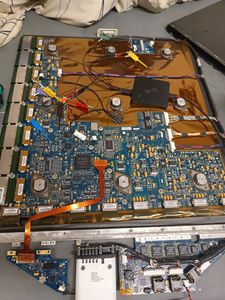
the Carbon fiber sleeve is held by 9 screws and can taken off without force.
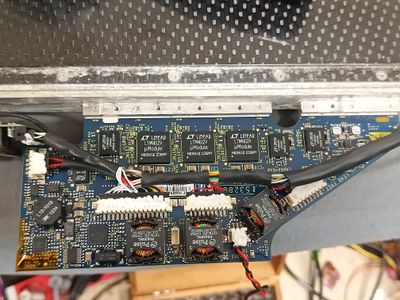
Power supply PCB
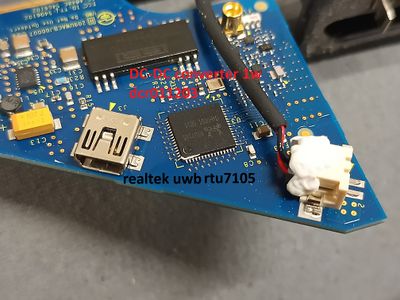
UWB PCB for Wireless USB using a RTU2705
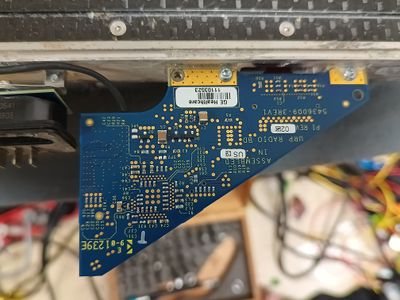
Backside of UWB PCB
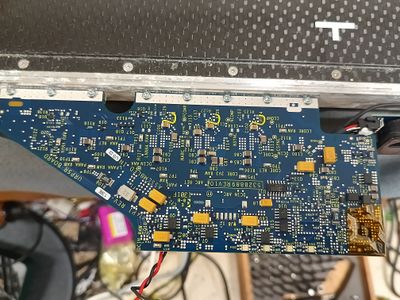
Backside of Power supply PCB
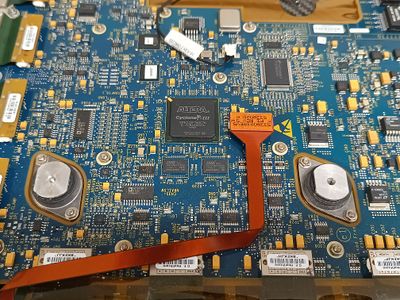
Main area of the PCB with its Altera Cyclone 3 FPGA
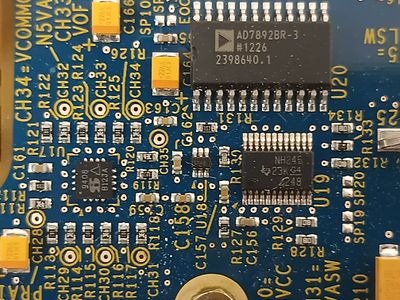
AD7892 is a 600ksps 12bit ADC, SN74LVC8T245 a 8bit bus transceiver and DG9408EDN a 8ch MUX
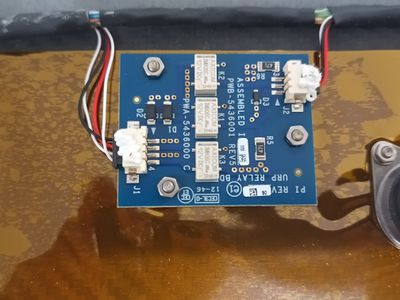
Isolation PCB for bottom connector
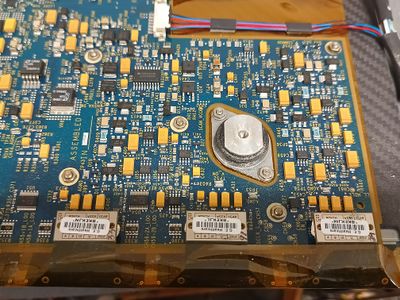
Powersupply section for FPGA and ROIC
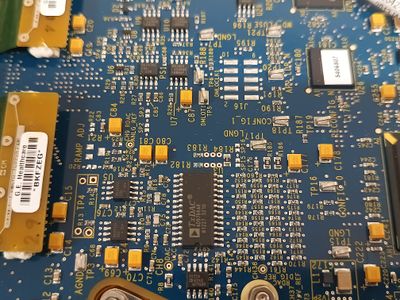
AD9764AR 14-Bit, 125 MSPS DAC and DS1682 integrated elapsed-time recorder
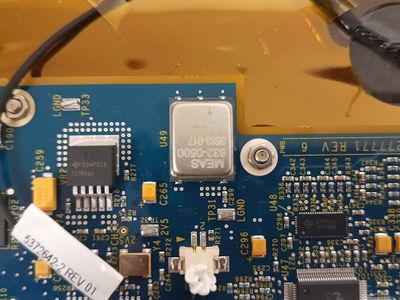
Accelerometer is a 834-0500 500G 3 Axis unit, and TJ500AE SPDT gigabit LAN switch
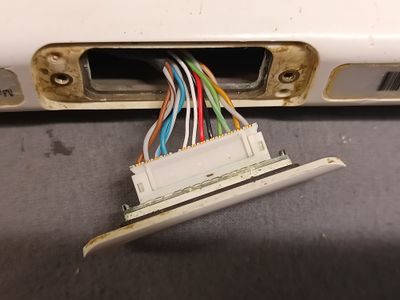
bottom connector for docking stand
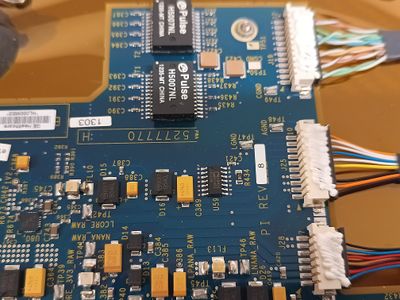
Ethernet transformers and ADM34 RS-485/RS-422 Transceiver
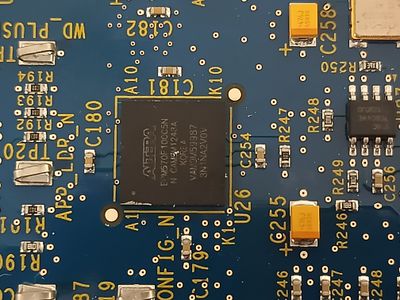
Altera EPM570f100c5n CPLD
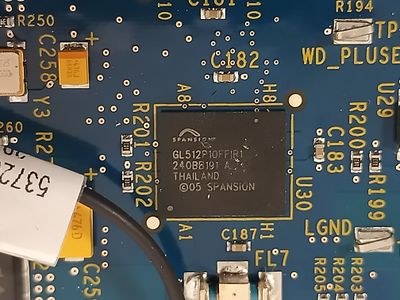
Spansion GL512P10FF1R1 512 Mbit NOR flash IC holding everything
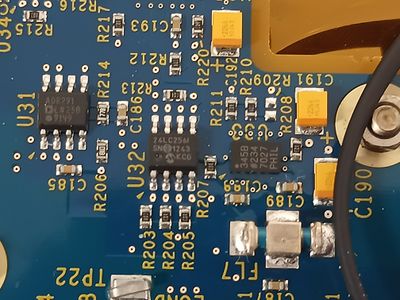
24LC256I 32k EEPROM for storing the accelerometer events


Main test py script: Usage and Parameters
current iteration found here: https://pastebin.com/vEfAresk
flashpad_acquire.py is a single file Python 3 tool that speaks the FlashPad URP/PDAP protocol over UDP. It implements discovery, the control handshake, script download and execution, sensor readout, full data backup, and the host registration (pairing) write. It requires only the Python standard library.
Default network configuration
These defaults match the values in ConnectionPoint.cfg and can be overridden on the command line.
| Setting | Default | Meaning |
|---|---|---|
| Detector IP | 192.168.1.30 | the panel; listens for all commands on UDP 8100 |
| Host IP | 192.168.1.1 | this machine, announced in SYSTEM_STARTUP |
| Detector port | 8100 | where commands are sent |
| Host command port | 5550 | where the detector returns protocol replies |
| Host image port | 6660 | where pixel data would stream |
| Discovery port | 4500 | where the detector sends its beacons |
Connection and general options
| Option | Default | Effect |
|---|---|---|
| --detector-ip IP | 192.168.1.30 | detector address |
| --host-ip IP | 192.168.1.1 | host address sent in SYSTEM_STARTUP |
| --output-dir DIR | . | where raw images are written |
| --timeout SECONDS | 5.0 | UDP receive timeout |
| --exec-timeout SECONDS | 60 | how long to wait for EXECUTION_COMPLETE |
| --skip-discovery | off | send SYSTEM_STARTUP once and proceed, skipping the discovery loop |
| --quiet | off | suppress the verbose per packet log |
Read and diagnostic modes (non destructive)
These only read from the detector. None of them write anything.
| Option | What it does | What to expect |
|---|---|---|
| --sensors | Reads the full 32 entry sensor table using cmd 0x7902 (converted) and 0x7900 (raw), side by side. | A decoded table of supply rails in volts. Temperatures show as railed. Unimplemented sensors (accelerometer DEM id, battery, grid) are flagged as stale. |
| --no-roe-init | With --sensors, skips the Script7 ROE init before reading. | Slightly faster sensor read, marginally less reliable. |
| --probe-data | Reads DetectorInfo, the HostList (registration state), and cal results via the upload protocol (cmd 0x13/0x14). | A hexdump and text decode of each. Shows whether any host is registered and which HostId the detector expects. |
| --backup [DIR] | Sweeps all upload IDs 0x00 to 0xFF and saves every readable blob to DIR/detector_backup_timestamp/. | A manifest plus one .bin per readable ID, including the full 64 MB flash image and the calibration maps. Do this before any write. Large blobs take a few minutes each. |
| --backup-range LO-HI | Limits the --backup sweep, for example 0x40-0xA0. | Faster, partial backup. |
| --dump-scripts | Prints the wire bytes of all built scripts as hex and exits. | No network activity; useful for inspecting the script encoding. |
| --listen | Passively listens on the host command port for 30 seconds. | Prints any packets the detector sends; useful for watching beacons. |
Acquisition modes
The default invocation (no mode flag) runs a standard acquisition, which requires an actual X-ray exposure to complete.
| Option | What it does | What to expect |
|---|---|---|
| (no flag) | Standard acquisition (Script 0). | Needs an X-ray exposure to reach EXECUTION_COMPLETE. |
| --dark | Runs the dark/offset acquisition (Script 1) before the standard one. | Two acquisitions; the dark one needs no X-ray. |
| --dark-only | Runs only the dark acquisition (Script 1). | Completes in a few seconds with no X-ray. The detector acquires and holds an 8 buffer image. Best way to test the full flow. |
| --no-standby | Omits the Script 8 standby loop. | Use if the standby loop blocks acquisition. |
| --two-exec | Executes Script 7 alone, waits, then Script 1. Only with --dark-only. | Tests the two stage execution hypothesis. |
| --parallel | Answers the detector status query (0x30000) with the cmd 0x99 ParallelImageTransfer reply instead of cmd 9. | Experiment to see if the parallel reply triggers a pixel push. (Result so far: it does not.) |
| --sweep-acq | Sweeps the dark acquisition across type_mode and transfer_mode values, watching for a 0x0F pixel push. | Non destructive experiment; reports which combination, if any, makes the detector stream. |
| --preview | Single dark acquisition on the preview path (transfer_mode 2, 4 buffer image). Watches port 6660 for a push. | One clean connection; run a packet capture on the detector address in parallel. |
Note: at present the detector acquires and holds an image but does not push the 0x0F pixel frames. The acquisition modes complete the handshake and acquisition, but image streaming is still being investigated.
Registration and write operations
These can write to the detector's flash. Every write is a dry run by default and only takes effect when --commit is added. Always run --backup first.
| Option | What it does |
|---|---|
| --register-self | Adds this host to the detector HostList and sets it as the primary host, so the detector should stream images to it. Appends an entry, sets IndexToPrimaryHost, recomputes the CRC, and writes via id 0x71. Dry run unless --commit. |
| --host-mac MAC | The MAC of the interface talking to the detector, used to derive this host's HostId for --register-self. Default 00:6f:00:01:0a:3a. |
| --smoke-test-write | Reads the HostList and writes back the identical bytes to validate the write and commit path without changing anything. Dry run unless --commit. |
| --restore-hostlist FILE | Writes a saved HostList blob (for example detector_backup_*/upload_0x71_504.bin) back to the detector. This is the undo button. Dry run unless --commit. |
| --commit | Arms the actual flash write for the operations above. Without it they only print what they would do. This writes the detector's flash and is irreversible at the chip level, although the HostList region can be restored from a backup. |
Typical workflow
- Read the current state:
python flashpad_acquire.py --probe-data - Make a full backup:
python flashpad_acquire.py --backup - Check sensors and power rails:
python flashpad_acquire.py --sensors - Dry run the registration:
python flashpad_acquire.py --register-self --host-mac YOUR:MAC - When satisfied, commit it: add
--commit - If needed, undo:
python flashpad_acquire.py --restore-hostlist detector_backup_*/upload_0x71_504.bin --commit
Known Dead Ends
Things that were tried and did not work or led nowhere:
- 0xBEEF (48879) as reply port
- This was a bug in early test scripts. The port has no meaning in the protocol. Use 5550.
- CmdFlag=1 as data packet flag
- Early scripts had the URP fields swapped, setting CmdFlag=1 on data packets. The detector ignores all PDAP content in these packets. Power cycle the detector if this happened, it may retain stale port state.
- Image data on alternate ports
- Tried listening on 48879, 6660, 5550, 8100, 1050, 6661, 9999, 4444, 7000, 7001, 9001. Nothing arrived on any of them.
- PORT_SETUP byte order (big-endian)
- Current implementation sends port fields as big-endian. If the detector reads them as little-endian it computes port 44565 and 1050 instead of 5550 and 6660, which would explain why no image data arrives. Not yet confirmed.
- Image data streaming automatically after EXECUTE_SCRIPT
- Frames may not push during execution at all. The detector may require an explicit IMAGE_RETRIVAL_REQUEST (cmd_type=0x41) and IMAGE_RETRIVAL (cmd_type=0x98) after the 0x30000 notification before it streams anything. Not yet tested.

