Silver Spring Networks Access Point: Difference between revisions
Add on-air identification — EUI-64 addressing, mesh-root role, backhaul |
Categorisation per 2026-09 category review |
||
| Line 31: | Line 31: | ||
link-quality metric. In one capture a relay was dual-homed to two access points | link-quality metric. In one capture a relay was dual-homed to two access points | ||
(a stable primary and a volatile secondary) for the whole observation window. | (a stable primary and a volatile secondary) for the whole observation window. | ||
[[Category:Silver Spring Networks]] | |||
[[Category:Protocol analysis]] | |||
Latest revision as of 14:42, 29 September 2026
-
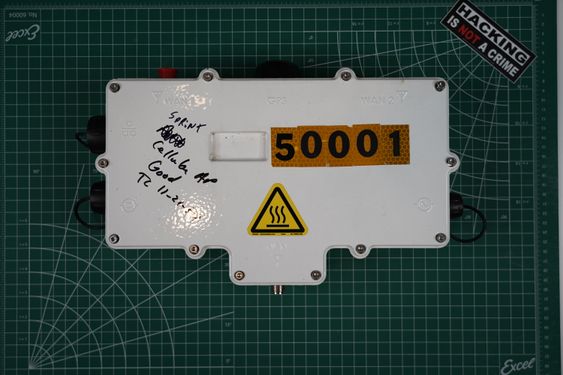 Top of Housing
 -
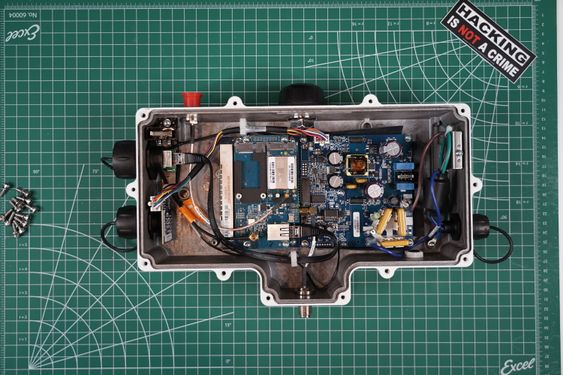 Interior showing cellular modem and circuit boards
 -
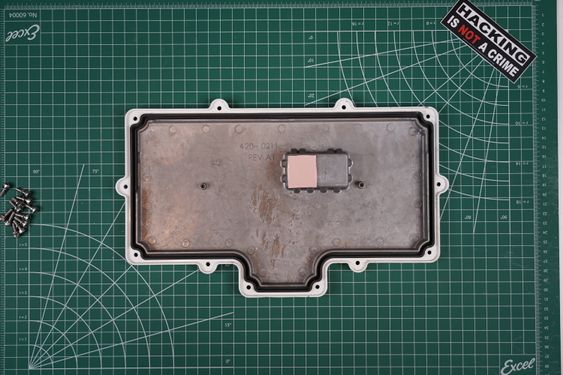 Inside of metal lid
 -
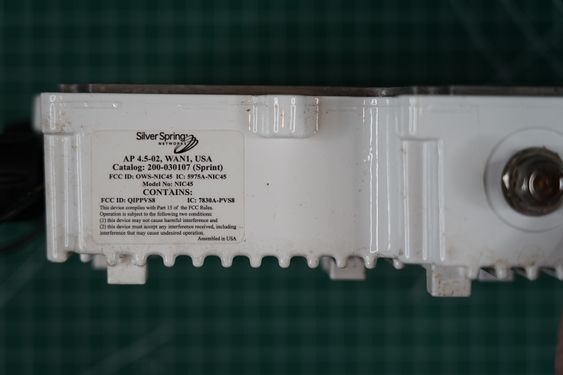 Model number
 -
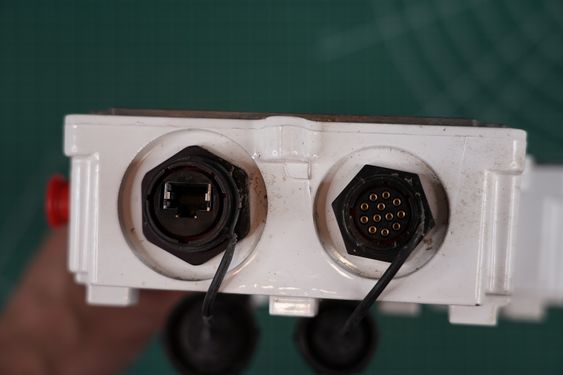
-
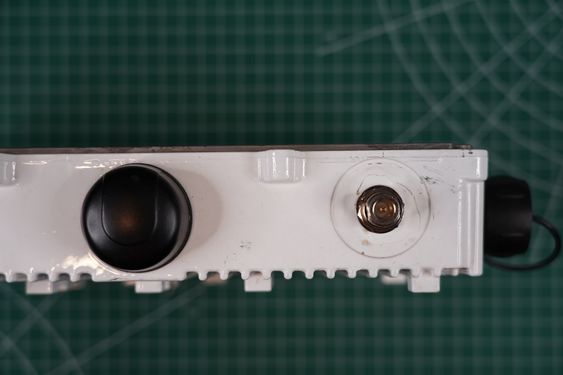 GPS and cellular antenna connector
 -
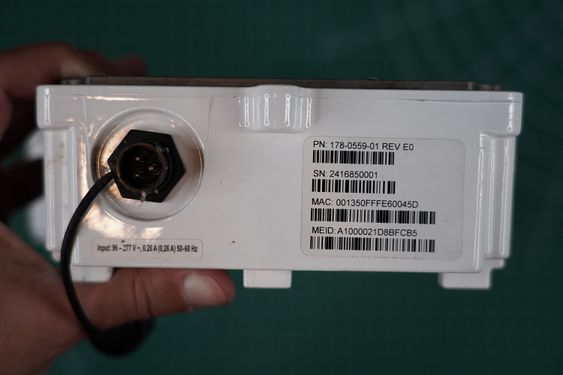 Power connector


On-air identification and role
(From passive capture of a fixed-AMI NIC 511 network — see Silver Spring Networks Protocol for the frame format.)
Access points are the root of a local mesh cell: endpoints and relays route toward them, and they backhaul to the utility head-end over cellular (the modem in the teardown photos above) or fibre.
They are addressed by EUI-64, distinct from endpoint meters:
- Access point / infrastructure:
00:13:50:FF:FE:60:xx:xx:xx— the
Silver Spring OUI00:13:50with the standard MAC-48 → EUI-64FF:FEexpansion. The Itron OUI00:07:81is also seen post-acquisition.
- Endpoint meters: serial form
00:13:50:05:00:xx:xx:xx.
An access point is not heard directly from an endpoint's vantage — it sits on the far side of the tree on channels a fixed receiver near one meter does not follow. It is identified instead by reference: a relay lists its uplink access point(s) in its beacon's neighbour records, each with a link-quality metric. In one capture a relay was dual-homed to two access points (a stable primary and a volatile secondary) for the whole observation window.